In the September of 2012, the Year 2 class on the Art and Design course at Walsall College were given their Final Major project brief. Entitled Fragments, they had until June to complete a final piece of artwork that would be displayed in an exhibition and provide them with their final grade.
The word 'Fragment' can be taken in several different ways.
After much deliberation, the first idea was chosen and then expanded upon. The original idea was to create a 'world' (literally a 2D Earth) made up of every day items - the landmass would consist of the latter and the sea would be a cotton sheet. A film would then be created consisting of FRAGMENTS of everyday life and everyday people. This film would be back projected onto the earth.

 Due to the nature of the project, it was vital that the film was appealing to all ages and in a way personalised - showing the world from the point of view of one individual. Film inspirations included Ellie Goulding's 'Your Song' (http://www.youtube.com/watch?v=D9AFMVMl9qE) for the cinematography, and 'Chairs are Like Facebook' (http://vimeo.com/57263769) for the idea: that underneath all the materialistic objects and things we are - at the end of the day - what really matters.
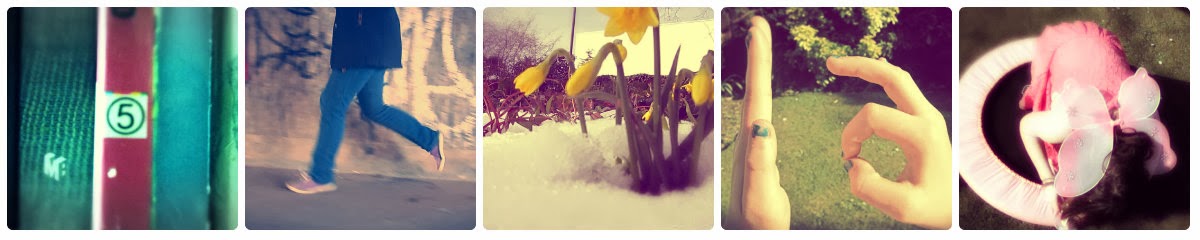
The filming process was all done on a Canon IXUS and edited on Windows Movie Maker. The whole project took approximatly 7 months. Several experiments were made whilst filming including filming with a compact camera through a film camera, like so:


 |
http://vimeo.com/82612300 |
- A small part broken or separated from something
- An individual piece of an object
- A break or divide
- A small part of something larger
- Lots of small fragments from every aspect of your life can join together to create your world as a whole.
- Deterioration, decay – flowers, literal things, fragmented memories, beauty in decay.
- Fragmented history, glimpses of events, old letters, found objects from the past, out of place and time etc.
- Falling away, leaving yourself behind in another place, daydreaming, fragments of dreams etc.
 |
| (Some of the other explored areas - individual's artwork) |
Due to the nature of the project, it was vital that the film was appealing to all ages and in a way personalised - showing the world from the point of view of one individual. Film inspirations included Ellie Goulding's 'Your Song' (http://www.youtube.com/watch?v=D9AFMVMl9qE) for the cinematography, and 'Chairs are Like Facebook' (http://vimeo.com/57263769) for the idea: that underneath all the materialistic objects and things we are - at the end of the day - what really matters.The filming process was all done on a Canon IXUS and edited on Windows Movie Maker. The whole project took approximatly 7 months. Several experiments were made whilst filming including filming with a compact camera through a film camera, like so:
Stop motion animation was also used to create sped up sequences and the colouring of images. It was also necessary to do it frame by frame as the software was not able to reverse the playback. The beginning and ending sequences to the film are stop-motion and were influenced by the Title Sequence for the London 2012 Olympic Games Ceremonies: http://www.youtube.com/watch?v=A_GbUk9sicg
Time-lapse was
also included in the film, speeding up to a maximum of 400% in parts
such as the sunrise (which was then reversed to creae a sunset). Parts
of the video was filmed in 1080p and some of the files corrupted,
therefore distorting the video but adding a rather surprisingly
effective addition to the film.
The film begins and ends with the same image as it is intended to be played on a loop. The music is by Reliant K and is called 'Getting into You'. You can listen to it here:
Comments
Post a Comment